As She Feels Her Hijab in the Breeze

© Rachel Peet

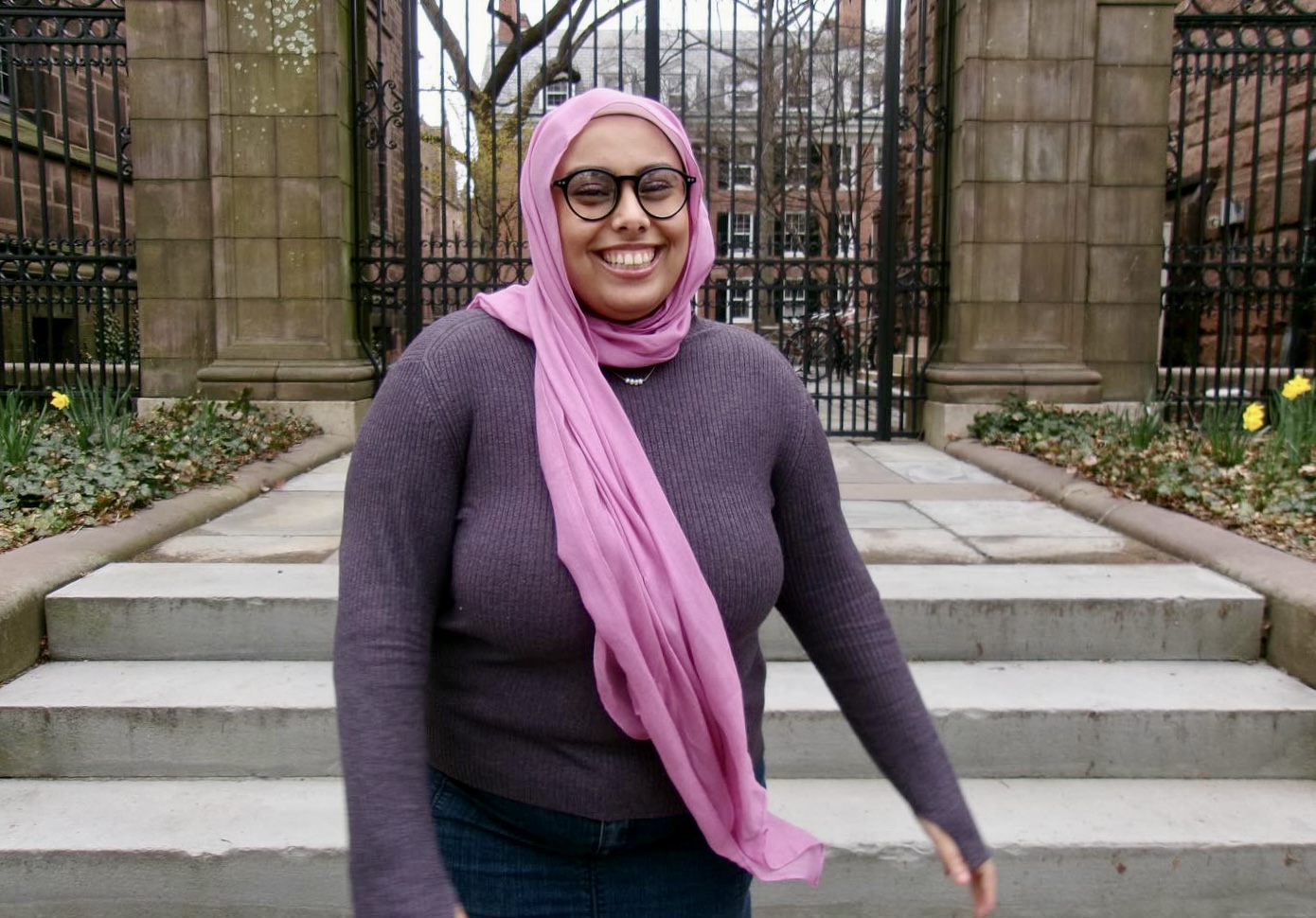
For 18-year-old Reem, a recent high school graduate, the daily ritual of pinning up her hijab, clasping her Iraq-shaped necklace, and draping her black and white keffiyeh over her shoulders has brought her closer to a sense of freedom than ever before.

Having been a refugee from Iraq and Syria, Reem understands that freedom can feel very distant for the “caged birds” in our migrant community. Her familiarity with the apprehensive voices experienced by many refugees and people of color has inspired her to study Human Rights at the University of Connecticut this fall.

Reem’s journey of advocating for human rights began with her connection to IRIS. She was only four years old when she, her younger sister, and her mother arrived in the States in 2009 to seek a safer and more hopeful life. Initially, IRIS provided financial aid and resettlement support for her family and extended relatives. By 2015, when her aunts, uncles, and grandmother arrived to reunite with them through IRIS —a vivid and unforgettable memory for Reem—she was well on her way to resisting the systemic barriers around her. The reconnection with her youngest aunt was especially inspiring.

In the following years, the bond between Reem and her aunt strengthened through their involvement with the Youth Leadership group as IRIS. This group of immigrant and refugee women met once a week to explore leadership activities as they navigated their first years in the States. Some of Reem’s cherished memories from the group include local field trips to nearby museums, the New Haven Public Library, and Hammonasset Beach, during which they learned about the local history and impact on immigrant populations over time, especially migrants of color in New Haven.

One of the most memorable workshops from Reem’s time with the Youth Leadership group was an introduction to the history of the Black Panther Party (BPP). As they carried old photographs around and from downtown New Haven, Reem and her friends were transported back to the 1960s and 70s, when the Black Panthers sought to protect and liberate long-discriminated Black neighborhoods. As an aspiring photographer, Reem was struck by the lack of change between these historical images and the present view, which fueled her passion for advocating for human rights. Inspired by Malcolm X and the BPP’s slogan, she felt a strong need to create “Freedom by any means necessary” for the greater good of the global migrant community.

Throughout her sophomore and junior years of high school, Reem emerged as a pioneer for the Youth Leadership group. She planned numerous lessons on social justice, racism, and other contemporary issues, opening up her perspective and those of her peers. One of her favorite lesson plans highlighted the evolution of women’s suffrage and its correlation to present day women’s rights. Reem’s exposure to IRIS were seeds that would eventually flourish her enthusiasm for social justice, particularly at her school, Wilbur Cross High School.

In her final years of high school, Reem participated in multiple protests for oppressed populations and even organized a student-led walk-out within the New Haven Public School system. The walk-out in May of 2022 involved more than 600 students protesting against School Resource Officers (SRO’s) and their discriminatory actions towards students of color and their rights to freedom of speech. 

“It was really cool marching in the streets alongside people who have similar perspectives and drive. It’s an indescribable feeling. You’re so present with all the passionate emotions of all those who are involved,” Reem said.

Even within the walls at Wilbur Cross High School, Reem grew impassioned as a social justice advocate. Her favorite course studied African American and Latinx cultures and history in the United States. The passion of her teacher motivated her to delve deeper into human rights and social justice through her involvement in school clubs such as Student Council, The Proclamation (the student newspaper), and the National Honors Society.

As Reem recognizes the cyclical and stark connections between past and present injustices, she has started to reconnect with her Middle Eastern culture, family, and beliefs. Just last summer in 2023, Reem decided to start wearing her hijab. With her aunt being a source of support in her life, Reem looked to her for guidance in making such a big decision. 

“When I was deciding my hijab journey, she was a huge help in really emphasizing that it was my personal decision and no one else’s. She reminded me that if I choose to wear my hijab, it was a decision only between myself and Allah, just like any other decision. There’s no need to listen to others and do what they say or want. She’s one of my greatest inspirations in life,” Reem shared.

As an Iraqi-American who often feels like she’s living two lives in the States, the ability to make such choices for herself has brought Reem greater freedom. It’s the choice to wear her hijab, to speak more Arabic with her loved ones, to carry her keffiyeh across her shoulders every day, to celebrate Islamic holidays like Ramadan, and to embrace her Middle Eastern roots. This is what sets Reem free, allowing her to share her voice with the ever-evolving melting pot of cultures in America. The blend of experiences with IRIS, her aunt, her high school education, and the influence of social justice poets like Maya Angelou and Refaat Alareer have all contributed to the amplification of her own words. In a recent senior speech reflecting on Alareer’s “If I Must Die” poem, Reem shared the following:

“He teaches me to never be silenced by anyone and to speak my truth even if no one in the room agrees with me or has the confidence to speak up. He teaches me to wear my keffiyeh, hijab, and Iraqi necklace with pride in every space I step foot in. I am proud of my brown skin that gleams in the sun. I am proud to be born in Iraq. I am proud to be a refugee. Generations behind me in my footsteps to future endeavors. I shine everywhere I go. I am a woman who is not afraid of death. I want my life to be remembered – to be told at family gatherings, at a graduation speech. To never be erased.”

Reem is proud to toss her graduation cap as she embarks on yet another transformative chapter with her hijab freely flowing in the breeze. 
Check out our new merch shop!

IRIS CT merch - tshirts and products to support immigrants

Your purchase directly supports refugees and immigrants—providing housing, education, and hope. Every item makes a difference.

PUBLISHED BY THE DAY Oct 29, 2025

AG Tong, talking immigration in New London: 'They will make it if we fight for them'

 
tong-speaking-on-immigration

Attorney General William Tong speaks at All Souls Unitarian Universalist Congregation in New London on Wednesday, Oct. 29. The event by Integrated Refugee & Immigrant Services focused on the impact of President Donald Trump’s immigration crackdown. (Alison Cross/The Day)

By Alison Cross
Day Staff Writer
 
New London — State Attorney General William Tong visited the city Monday evening to share a message of hope and resistance amid President Donald Trump’s immigration crackdown.
The event at All Souls Unitarian Universalist Congregation was organized by Integrated Refugee & Immigrant Services, the New Haven-based nonprofit known as IRIS.
Since 1982, IRIS has welcomed and resettled thousands of refugees and immigrants within the state, but Maggie Mitchell Salem, the organization’s executive director, said new federal policies have upended longstanding pathways to legal immigration.
As a result of these changes, Mitchell Salem said IRIS will not participate in the U.S. government-supported refugee admissions program for the first time in the nonprofit’s history, starting on Jan. 1. Mitchell Salem said IRIS will continue to resettle refugees from Afghanistan and other countries without federal funding.
During his speech, Tong described the Trump administration’s policies and actions over the last nine months as “awful, brutal, (and) painful.” Tong spoke about lawsuits he has filed against the federal government to block the Trump administration from ending birthright citizenship and coercing states into following the administration’s immigration agenda.
Tong said people often put refugees and immigrants into separate categories but “very often they’re one and the same.”
“My grandparents and my dad ran for their lives (from China),” Tong said. “I’m a kid that comes from refugees and immigrants. I grew up in a Chinese restaurant. … If you go to a takeout joint around here and you see a high schooler ring up your Tuesday night takeout, that was me.”
“In one generation, I went from that hot Chinese restaurant kitchen in the state of Connecticut in Wethersfield, to being the 25th attorney general of the state,” Tong continued. “I don’t tell you that story because it’s a good story, I tell you that story because it is an unremarkable story. It is a story shared by so many people. And there are kids right now, our kids in this city, the sons and daughters and grandchildren of refugees and immigrants who are just like us … and I know they will make it if we fight for them right now.”
Maryam Elahi, the president and chief executive officer of the Community Foundation of Eastern Connecticut, said that right now, children are not getting an education because “so many parents are terrified to take their kids to school (and) pick them up.”
“This is not acceptable,” Elahi said.
Elahi encouraged people to reframe the way they speak about immigrants.
“Unless you’re a Native American, you’re an immigrant in this country,” she said. “Some of us came earlier on boats. Some of us came later by foot or plane or both, but the end result is the same. It’s really important for all of us to change the narrative, to talk about immigrants as all of us, to talk about immigrants as people who bring so much richness to our community and to put our arms around them.”
Jeanne Milstein, the human services director for the city, said that New London’s history is rooted in immigrant communities who have made the city stronger.
“It is our diversity which is our strength. New London is a seaport town. It has always been a rich mix of people. It is a community where everyone is welcome,” Milstein said. “The feds may be trying to kill the American dream, but here in New London, it is alive and well.”

PUBLISHED BY THE HARTFORD COURANT

After four decades, CT organization won’t resettle refugees this year. Here’s why

For the first time in more than four decades Integrated Refugee & Immigrant Services made the decision to not resettle refugees through the United States Refugee Admissions program, due to the Trump administration’s intent to shift the program’s focus.
“We will not resettle populations that aren’t refugees,” said Maggie Mitchell Salem, director of IRIS. “That is basically the point. This is not about Afrikaners or right wing groups in Europe. This is not about ideology or politics. This is about our mission. Our mission is to resettle the world’s most vulnerable people who have been screened for the credible fear they possess which keeps them from going home.”
Mitchell Salem added: “We are not a relocation service. We work with and for a very specific population and as part of the humanitarian pathway within this immigration system.”
The New York Times reported Wednesday that the Trump administration “is considering a radical overhaul of the U.S. refugee system that would slash the program to its bare bones while giving preference to English speakers, white South Africans and Europeans who oppose migration.” 
The Trump administration has said that white South African farmers face discrimination and violence at home, which the country’s government strongly denies.
The IRIS board made the decision last month to change course after learning about the Trump’s administration’s plans to change the refugee program, including limiting the number of refugees to 30,000 to 40,000, Mitchell Salem said.
“That only reinforced that decision,” Mitchell said. “We have never had to question the U.S. government’s decision. This is not about who is in charge of our government. We have supported refugee resettlement in Republican administrations, and Democratic administrations without fail. We had to do some critical thinking about whether based on what we understood to be the administration’s policy on the U.S. refugee program, whether there was an alignment between our mission and how they were implementing the program.”
The Church World Service, which IRIS is an affiliate of, and contracts with the State Department to help refugees “expressed its dismay and deep concern in response to the Trump administration’s plans to reduce the refugee admissions’ goal “to the lowest level in history,” according to a press release from the agency.
New numbers reported from the Associated Press suggest the Trump administration is considering admitting far fewer refugees than IRIS had initially learned, with just 7,500 admitted.
Dana Bucin, an immigration attorney and partner with Harris Beach Murtha in Hartford, said the administration’s ban against refugees at the beginning of 2025 is not advisable.
“The entire policy that is against refugees in particular is harmful at a time when the world is seeing a record number of refugees due to wars, civil wars, famine, climate change and a bunch of other factors,” she said. “We have never had so many refugees as we do now and so few tools to deal with them and so definitely in general an anti-refugee policy is not conducive to humanitarian endeavors.”
Bucin said she does not believe that all Afrikaners qualify as a group for refugee status.
“But as attorneys we are open to hearing of any individualized case of persecution for Afrikaners, much like anyone else,” she said.
Since the Trump administration suspended the refugee program in January, IRIS relocated its New Haven office and had to shut its Hartford office.
In fiscal year 2024, IRIS served more than 2,000 people and resettled 900 refugees.
In fiscal year 2025 they were planning to resettle 800 refugees but have only been able to settle 241 refugees as many were denied entry or delayed.
As a result of the suspension of the refugee program, IRIS lost about $4 million in funding and had to lay off employees.
In the United States, some 128,000 refugees have currently been approved for resettlement in the United States and are now stuck in limbo, said Mark Hetfield, president of HIAS, the Jewish refugee resettlement agency. In addition, 14,000 Jews, Christians and other religious minorities in Iran have long been registered with the refugee program.
New vision
IRIS is not suspending its activities though. The organization is realigning its focus to help refugees and immigrants with assistance securing housing, food, addressing health issues and advocating for more English Language Learning programs to help them succeed in the workforce, Mitchell Salem said.
Mitchell Salem said she is concerned about provisions in Trump’s Big Beautiful Bill particularly eliminating SNAP for refugees. She said IRIS needs more support to provide basic proteins for refugees in its food pantry.
Targeting ELL programs aligned to workforce development programs is critical, she said, so “people are getting the right vocational training and entering these programs successfully and entering higher paying jobs in the healthcare, hospitality and manufacturing sector. This is a win for the state. The state has to become more competitive.”
Mitchell Salem said IRIS will focus on deepening partnerships with the Chambers of Commerce and workforce boards and adult literacy organizations that exist in every town and city in the state.
In addition to those being barred from entering the country, Mitchell Salem said immigrants who are here are being terrorized. Calling it inhumane, Mitchell Salem said rounding up of people in the community at their place of employment is having an impact on everyone.
“It is going to impact the price of food and whether your grandmother is being taken care of in an assisted living community,” she said. “It is impacting employers. It is impacting tax bases. You don’t remove this significant number of people from our community and have no impact.”
With ICE arrests continuing in Connecticut and immigrant advocates calling for state officials to act, lawmakers are in discussions about increasing legal protections during an upcoming special session.
ICE agents stormed a Hamden car wash Wednesday and detained and took away eight people including a husband and wife and a customer, according to information from state Sen. Jorge Cabrera’s office.
“Since we passed the TRUST Act a decade ago, Connecticut has always carved out exceptions for dangerous felons,” Cabrera said in a statement. ”Democrats don’t have a problem with that. Neither does the governor. What we do have a problem with is Donald Trump and ICE telling us that they are arresting the scum of the Earth – murderers and gang members and pedophiles. And then who do they arrest? Landscapers. Dishwashers. High school kids. People working at car washes.”
The Associated Press contributed to this report.

Originally Published: 

October 17, 2025 at 5:37 AM ED