A Family Company Expands the Definition of Family

A Family Company Expands the Definition of Family

Written by Grady Trexler | Photography © John Curtis

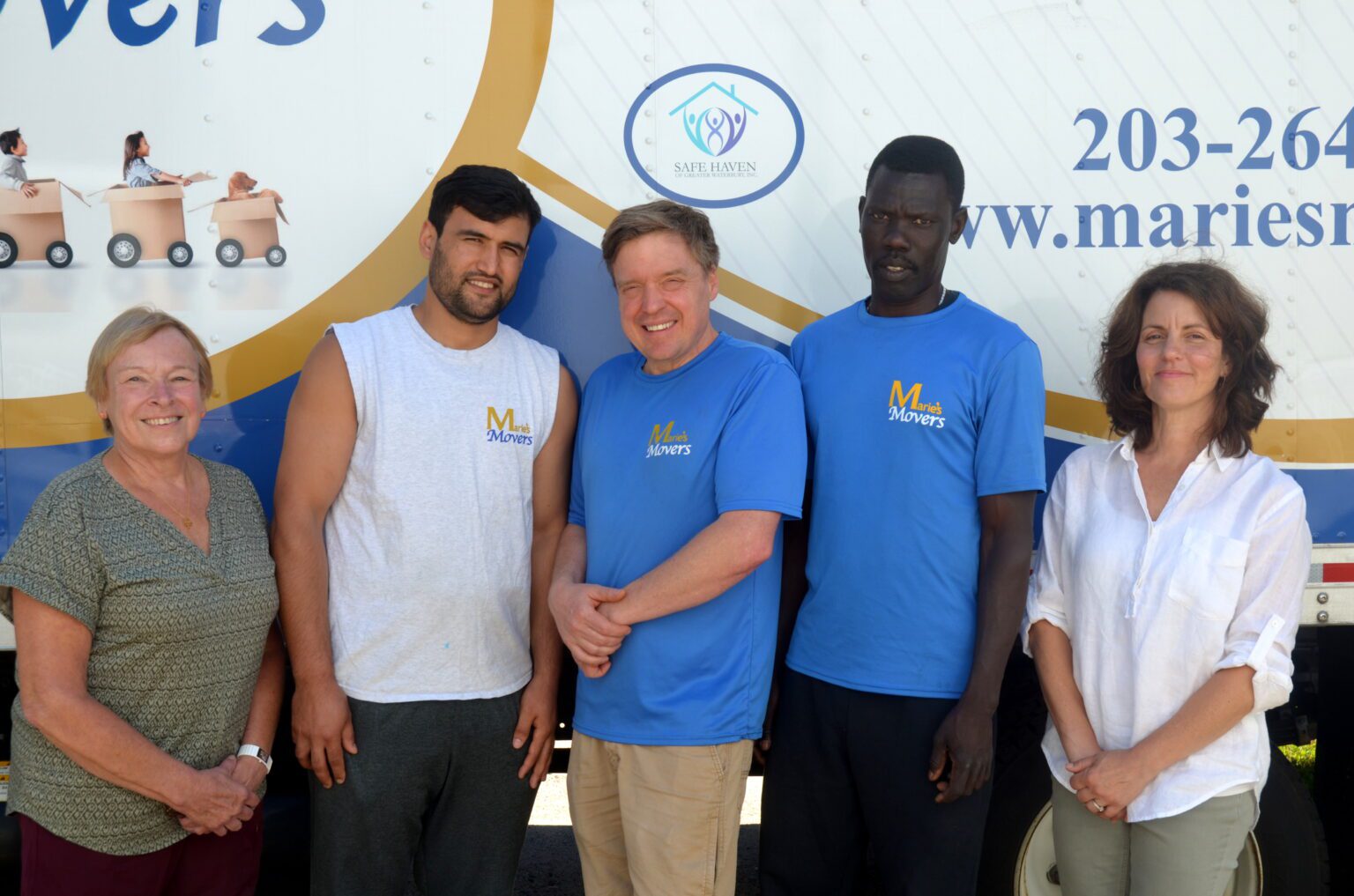
On a recent afternoon in June, at the Marie’s Movers warehouse in Oxford, Conn., Jim Anctil had two crews arriving—one from as far as Baltimore—and another getting set to make a local delivery. As his employees trickled in, ready to go home after a long drive, or preparing to make another delivery, crew members joked and chit-chatted amidst stacks of furniture waiting to be moved or donated.

On any day Anctil may have up to five crews working in the lower 48 states. His employees are an eclectic bunch. While most are from rural Connecticut, he also hires from non-traditional employment pools, including some from workforce development programs in New Haven. He’s also hired four IRIS clients, two of which, Javid Mohammadi and Anur Abdella, are still on the payroll. Anctil also works with IRIS co-sponsorship groups and moves furniture around Connecticut and beyond for IRIS clients and new arrivals—pro bono when he can afford it, and often at greatly reduced rates.

Marie’s Movers, named for Anctil’s mother, grew out of her store, Marie’s Country Furnishings. In addition to selling furniture, the store also offered moving and delivery services. After Anctil’s mother retired and closed the store, he pivoted to running Marie’s Movers as a full-time moving service. He operates the company along with his business partner, Karen Bresson.

Anctil got involved with IRIS in 2017, in the wake of then-President Donald Trump’s Muslim ban, when he reached out to Bethany Delahunt, the Housing and Donations Manager at IRIS, to offer his help. Anctil already had already worked with nonprofits to set up low-income housing apartments, or source donations to such charities as Safe Haven of Greater Waterbury. “We pretty much stock their thrift store,” he says.

For IRIS, he donated furniture acquired from clear-outs—the stuff that homeowners left behind—and offered his crews to move furniture for new arrivals. “It was really exciting and almost too good to be true,” says Delahunt. IRIS, she says, is responsible for providing a clean, safe, furnished apartment for new arrivals.

“It’s like a home makeover,” says Delahunt, who works from a federal checklist of required items, everything from mattresses and bedframes to baking pans and tea kettles. “Everybody wants a tea kettle,” she says.

Moving furniture takes time and labor, which Delahunt often struggles to find. In addition to furnishing apartments, IRIS collects furniture from donors’ homes. “There’s just been so many times where he just showed up with his team, and they did the job in an hour or two when it would have taken us all day or two days,” Delahunt says. When on one occasion volunteers cancelled at the last minute, Anctil showed up and unloaded furniture with one other volunteer. “They spent hours clearing out this house,” Delahunt says.

His work with IRIS led Anctil to connect with New Start Ministry, a co-sponsorship group in Woodbury, Connecticut, that helped Mohammadi and his family settle in Connecticut. “If there’s some furnishings that we’re having difficulty finding, he’ll donate it. If there’s something that needs to be moved, he’ll find a truck and some time,” says Susan Suhr, a co-leader of the group.

The ministry, a coalition of 12 houses of worship from six towns in the Woodbury area, doesn’t rely on Anctil for everything, Suhr says. They usually try to recruit community volunteers to help, but sometimes they can’t find or transport a certain piece of furniture. “Jim is there when we need to do those things,” she says.

Mohammadi and Abdella, both of whom came to the United States through IRIS and were resettled in partnership with co-sponsors, are the third and fourth IRIS clients Anctil has hired.

For many newly arrived families, finding a job is one of the last hurdles to self-sufficiency. “Employment, other than learning English, is the most important thing, because that is your key to independence,” says Cindy Dunn, a co-leader of the Interfaith Partnership for Refugee Resettlement, a Newtown-based co-sponsorship group that resettled Abdella and his family. “To have someone like Jim open the doors and say, ‘Yeah, I’ll hire him,’ is priceless.”
Abdella, who is from Sudan, arrived in the United States on March 18, 2020, as the covid pandemic began closing borders and the first wave of lockdowns began. At the age of eight, he fled warfare in Sudan and spent years in a refugee camp in Ethiopia before being able to come to the United States through the federal refugee resettlement program.

He’s been working with Marie’s Movers for a little over a year, but eventually wants to complete his education. After that, he says, he’ll decide his next move.

Mohammadi arrived in the United States in July of 2019. Originally from Afghanistan, he left for Turkey over a family dispute. He’s been working for Anctil since October 2019 and hopes to become a truck driver.

Anctil supports many of his employees, who number about 40, with more than a job. He would pick up Mohammadi at his home in Waterbury and drive him to the company warehouse in Oxford every day. When Mohammadi struggled to pass the written test for a learner’s permit, Anctil paid for driving lessons and let Mohammadi practice in his car. Mohammadi got his license and now drives himself to work. Anctil says he wasn’t surprised. “He’s a good driver.”
His employees come from other disadvantaged groups. Among his crews are young men from New Haven who have were formerly incarcerated, mostly for drug possession—people he sees as being failed by the system. “They quite often do time for something a kid in Southbury would get off on,” he says.

For Anctil, a rewarding aspect of hiring refugee clients is seeing his other employees learn about people and cultures that they otherwise wouldn’t know. There might be moments of tension—he once reprimanded an employee for what he perceived as a racist crack about a co-worker—but over time those tensions fade into acceptance. Now everyone wants Mohammadi and Abdella on their moving teams.

Since he reached out to Delahunt in 2017, Anctil says his motivation for being involved with IRIS has shifted. “I’m not a charity,” he says. Although initially moved by a desire to help, he sees hiring and supporting refugees like Mohammadi and Abdella as an investment. When he helped Mohammadi with his driving test, it ultimately benefitted him and Marie’s Movers. “They’ve become valuable parts of my company, so it’s a mutually beneficial relationship,” says Anctil. “It’s good for them and it’s good for me.”
PUBLISHED BY THE DAY Oct 29, 2025

AG Tong, talking immigration in New London: 'They will make it if we fight for them'

 
tong-speaking-on-immigration

Attorney General William Tong speaks at All Souls Unitarian Universalist Congregation in New London on Wednesday, Oct. 29. The event by Integrated Refugee & Immigrant Services focused on the impact of President Donald Trump’s immigration crackdown. (Alison Cross/The Day)

By Alison Cross
Day Staff Writer
 
New London — State Attorney General William Tong visited the city Monday evening to share a message of hope and resistance amid President Donald Trump’s immigration crackdown.
The event at All Souls Unitarian Universalist Congregation was organized by Integrated Refugee & Immigrant Services, the New Haven-based nonprofit known as IRIS.
Since 1982, IRIS has welcomed and resettled thousands of refugees and immigrants within the state, but Maggie Mitchell Salem, the organization’s executive director, said new federal policies have upended longstanding pathways to legal immigration.
As a result of these changes, Mitchell Salem said IRIS will not participate in the U.S. government-supported refugee admissions program for the first time in the nonprofit’s history, starting on Jan. 1. Mitchell Salem said IRIS will continue to resettle refugees from Afghanistan and other countries without federal funding.
During his speech, Tong described the Trump administration’s policies and actions over the last nine months as “awful, brutal, (and) painful.” Tong spoke about lawsuits he has filed against the federal government to block the Trump administration from ending birthright citizenship and coercing states into following the administration’s immigration agenda.
Tong said people often put refugees and immigrants into separate categories but “very often they’re one and the same.”
“My grandparents and my dad ran for their lives (from China),” Tong said. “I’m a kid that comes from refugees and immigrants. I grew up in a Chinese restaurant. … If you go to a takeout joint around here and you see a high schooler ring up your Tuesday night takeout, that was me.”
“In one generation, I went from that hot Chinese restaurant kitchen in the state of Connecticut in Wethersfield, to being the 25th attorney general of the state,” Tong continued. “I don’t tell you that story because it’s a good story, I tell you that story because it is an unremarkable story. It is a story shared by so many people. And there are kids right now, our kids in this city, the sons and daughters and grandchildren of refugees and immigrants who are just like us … and I know they will make it if we fight for them right now.”
Maryam Elahi, the president and chief executive officer of the Community Foundation of Eastern Connecticut, said that right now, children are not getting an education because “so many parents are terrified to take their kids to school (and) pick them up.”
“This is not acceptable,” Elahi said.
Elahi encouraged people to reframe the way they speak about immigrants.
“Unless you’re a Native American, you’re an immigrant in this country,” she said. “Some of us came earlier on boats. Some of us came later by foot or plane or both, but the end result is the same. It’s really important for all of us to change the narrative, to talk about immigrants as all of us, to talk about immigrants as people who bring so much richness to our community and to put our arms around them.”
Jeanne Milstein, the human services director for the city, said that New London’s history is rooted in immigrant communities who have made the city stronger.
“It is our diversity which is our strength. New London is a seaport town. It has always been a rich mix of people. It is a community where everyone is welcome,” Milstein said. “The feds may be trying to kill the American dream, but here in New London, it is alive and well.”

PUBLISHED BY THE HARTFORD COURANT

After four decades, CT organization won’t resettle refugees this year. Here’s why

For the first time in more than four decades Integrated Refugee & Immigrant Services made the decision to not resettle refugees through the United States Refugee Admissions program, due to the Trump administration’s intent to shift the program’s focus.
“We will not resettle populations that aren’t refugees,” said Maggie Mitchell Salem, director of IRIS. “That is basically the point. This is not about Afrikaners or right wing groups in Europe. This is not about ideology or politics. This is about our mission. Our mission is to resettle the world’s most vulnerable people who have been screened for the credible fear they possess which keeps them from going home.”
Mitchell Salem added: “We are not a relocation service. We work with and for a very specific population and as part of the humanitarian pathway within this immigration system.”
The New York Times reported Wednesday that the Trump administration “is considering a radical overhaul of the U.S. refugee system that would slash the program to its bare bones while giving preference to English speakers, white South Africans and Europeans who oppose migration.” 
The Trump administration has said that white South African farmers face discrimination and violence at home, which the country’s government strongly denies.
The IRIS board made the decision last month to change course after learning about the Trump’s administration’s plans to change the refugee program, including limiting the number of refugees to 30,000 to 40,000, Mitchell Salem said.
“That only reinforced that decision,” Mitchell said. “We have never had to question the U.S. government’s decision. This is not about who is in charge of our government. We have supported refugee resettlement in Republican administrations, and Democratic administrations without fail. We had to do some critical thinking about whether based on what we understood to be the administration’s policy on the U.S. refugee program, whether there was an alignment between our mission and how they were implementing the program.”
The Church World Service, which IRIS is an affiliate of, and contracts with the State Department to help refugees “expressed its dismay and deep concern in response to the Trump administration’s plans to reduce the refugee admissions’ goal “to the lowest level in history,” according to a press release from the agency.
New numbers reported from the Associated Press suggest the Trump administration is considering admitting far fewer refugees than IRIS had initially learned, with just 7,500 admitted.
Dana Bucin, an immigration attorney and partner with Harris Beach Murtha in Hartford, said the administration’s ban against refugees at the beginning of 2025 is not advisable.
“The entire policy that is against refugees in particular is harmful at a time when the world is seeing a record number of refugees due to wars, civil wars, famine, climate change and a bunch of other factors,” she said. “We have never had so many refugees as we do now and so few tools to deal with them and so definitely in general an anti-refugee policy is not conducive to humanitarian endeavors.”
Bucin said she does not believe that all Afrikaners qualify as a group for refugee status.
“But as attorneys we are open to hearing of any individualized case of persecution for Afrikaners, much like anyone else,” she said.
Since the Trump administration suspended the refugee program in January, IRIS relocated its New Haven office and had to shut its Hartford office.
In fiscal year 2024, IRIS served more than 2,000 people and resettled 900 refugees.
In fiscal year 2025 they were planning to resettle 800 refugees but have only been able to settle 241 refugees as many were denied entry or delayed.
As a result of the suspension of the refugee program, IRIS lost about $4 million in funding and had to lay off employees.
In the United States, some 128,000 refugees have currently been approved for resettlement in the United States and are now stuck in limbo, said Mark Hetfield, president of HIAS, the Jewish refugee resettlement agency. In addition, 14,000 Jews, Christians and other religious minorities in Iran have long been registered with the refugee program.
New vision
IRIS is not suspending its activities though. The organization is realigning its focus to help refugees and immigrants with assistance securing housing, food, addressing health issues and advocating for more English Language Learning programs to help them succeed in the workforce, Mitchell Salem said.
Mitchell Salem said she is concerned about provisions in Trump’s Big Beautiful Bill particularly eliminating SNAP for refugees. She said IRIS needs more support to provide basic proteins for refugees in its food pantry.
Targeting ELL programs aligned to workforce development programs is critical, she said, so “people are getting the right vocational training and entering these programs successfully and entering higher paying jobs in the healthcare, hospitality and manufacturing sector. This is a win for the state. The state has to become more competitive.”
Mitchell Salem said IRIS will focus on deepening partnerships with the Chambers of Commerce and workforce boards and adult literacy organizations that exist in every town and city in the state.
In addition to those being barred from entering the country, Mitchell Salem said immigrants who are here are being terrorized. Calling it inhumane, Mitchell Salem said rounding up of people in the community at their place of employment is having an impact on everyone.
“It is going to impact the price of food and whether your grandmother is being taken care of in an assisted living community,” she said. “It is impacting employers. It is impacting tax bases. You don’t remove this significant number of people from our community and have no impact.”
With ICE arrests continuing in Connecticut and immigrant advocates calling for state officials to act, lawmakers are in discussions about increasing legal protections during an upcoming special session.
ICE agents stormed a Hamden car wash Wednesday and detained and took away eight people including a husband and wife and a customer, according to information from state Sen. Jorge Cabrera’s office.
“Since we passed the TRUST Act a decade ago, Connecticut has always carved out exceptions for dangerous felons,” Cabrera said in a statement. ”Democrats don’t have a problem with that. Neither does the governor. What we do have a problem with is Donald Trump and ICE telling us that they are arresting the scum of the Earth – murderers and gang members and pedophiles. And then who do they arrest? Landscapers. Dishwashers. High school kids. People working at car washes.”
The Associated Press contributed to this report.

Originally Published: 

October 17, 2025 at 5:37 AM ED