New Americans

iris-RWB-swash

Building stability, belonging, and opportunity for refugees and immigrants in Connecticut and across the U.S.

Building Belonging

IRIS is here for you — whether you arrived 10 or more years ago or more recently. We work with individuals and families to help you access resources, secure a job, find educational programs or schools for your children, and other support to build a future for yourself and the people you love.
This is about more than services. It’s about feeling at home, part of a community, and moving forward with confidence. Our logo refresh captures what is so special about our country: that we are a nation of immigrants and that our laws, rights, and freedoms apply to everyone here regardless of immigration status. We combined our name with our flag. The flag’s wave represents the distances traveled, and hardships encountered, by many generations of Americans to reach safety and opportunity.
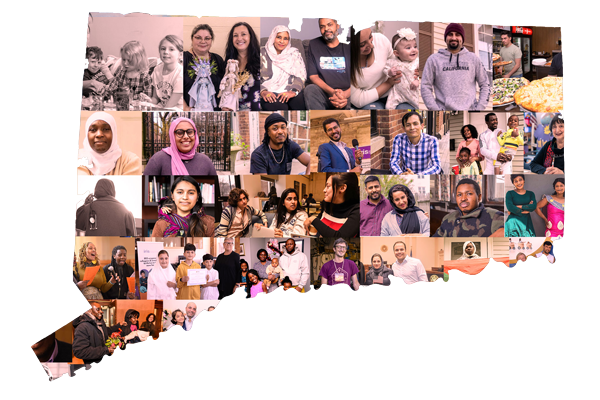
new-americans-in-ct

What Does "New Americans" Mean?

New Americans is actually nothing new — it’s how IRIS has thought of the many thousands of refugees and immigrants we’ve welcomed since 1982.  We believe that these newcomers deserve to be acknowledged as partners in the process of rebuilding their lives.  We also sustain the connections developed with community sponsor groups nationally so that we all remain engaged in support of those already here, and so that we are ready to welcome again.
The IRIS New Americans mark reflects four interconnected areas of support — Economic Mobility & Education; Immigration Status & Stability; Language Equity & Communication; and Community & Civic Engagement — all built on a foundation of day-to-day stabilization: housing, food, health, and hands-on case management.
These aren’t separate programs. They’re connected the same way your life is connected — because a family that can’t afford rent can’t focus on a career pathway. A parent who can’t communicate with their child’s school needs language access before anything else. Work authorization opens doors that nothing else can. And civic participation is what belonging looks like when it’s fully realized.
IRIS has always done this work. New Americans is how we say it clearly: this is the work, this is who it’s for, and this is why it matters now.

Supporting Stability

Before careers, legal cases, language access, or civic participation — people need a roof, food, and someone in their corner. IRIS provides a foundation of core stabilization support so families can move forward with confidence:

Help finding and keeping safe, stable housing

Through IRIS’s pantry and community partners

Connections to physical and behavioral health care

Flexible, trauma-informed support for families as they navigate multiple systems

As families stabilize, these same relationships become a bridge to everything else — connecting a rent-stressed family to financial coaching, a food pantry visitor to legal screening, a parent at a wellness group to leadership and volunteer opportunities.

Ways We Can Help

1

Economic Mobility & Education

Work, School, and Financial Stability
A job is a start. A career is a foundation. IRIS helps families move beyond basic self-sufficiency into real economic mobility — and into the kind of stability that lets you plan for the future, not just manage the present.
We build connections to employers, workforce programs, and educational resources across Connecticut, so the door to opportunity doesn’t just open — it stays open.
Ways we can help:
  • Job readiness and career coaching, with a focus on advancement over time — not just placement
  • Connections to living-wage career pathways in healthcare, education, manufacturing, and more
  • Help enrolling children in school and navigating placement, transportation, and key meetings
  • Family literacy, afterschool, and summer learning programs
  • Links to entrepreneurship resources, small business support, and micro-lending
  • Financial education, credit-building, and asset-development tools

2

Immigration Status & Stability

Legal Support and Immigration Services
You cannot plan a future you’re not sure you’re allowed to have. IRIS provides comprehensive immigration legal services — screenings, applications, legal clinics, and representation — to help you secure your status, stay with your family, and build toward citizenship.
We work alongside pro bono partners at law schools and firms across Connecticut so that even the most complex situations get the attention they deserve.
Ways we can help:
  • Immigration screenings and casework: family petitions, work authorization, green card applications
  • Support preparing for USCIS interviews and navigating required documentation
  • Family reunification — including help with travel restrictions, fees, and processing delays
  • Citizenship and naturalization assistance: application help, fee waivers, and step-by-step support
  • Regular legal clinics with law school and attorney partners
  • Referrals to pro bono legal representation
immigrants-at-iris

3

Language Equity & Communication

Language Access and Interpretation
Language access is a civil right and a cornerstone of equity and inclusion. When people cannot communicate in their own language, they are effectively excluded from the systems and services that shape their lives. IRIS is committed to dismantling that barrier.
Access to healthcare, education, legal services, and community life all depend on being able to communicate. IRIS makes sure language is never the barrier standing between you and the support you need, because true inclusion means every person can participate fully, regardless of the language they speak.
Ways we can help:
  • Professional interpretation for medical appointments, legal proceedings, school meetings, and more
  • Translation of key documents: IEPs, medical instructions, legal notices, housing paperwork
  • Multilingual resources and information across all areas of support
  • Interpreter training and professional development — with pathways to leadership for bilingual community members

4

Community & Civic Engagement

Know Your Rights and Stay Connected
Belonging isn’t just a feeling — it’s participation. IRIS helps immigrants and refugees understand their rights, stay informed about a rapidly changing policy environment, and engage in the civic life of the communities they call home.
We also work with Connecticut’s public officials — legislators, school administrators, mayors — to help institutions respond to immigration challenges with clarity, accuracy, and humanity.
Ways we can help:
  • Multilingual immigration updates and policy information — fact-based, regularly updated, accessible in your language
  • Know-your-rights resources and community education
  • Nonpartisan voter registration and civic education for new citizens and green card holders
  • Community events, volunteer opportunities, and connections to local civic life
  • Resources for local and state officials navigating immigration-related policy and enforcement challenges
  • Community sponsorship of refugees in Connecticut since 2014, and building on the national network of Welcome Corps 2023-2025, we continue to support and advance their acts of welcome and the future of our movement.
Undocumented

Why this matters now

Many families are facing real uncertainty — and support systems that once existed are shrinking.

IRIS is focused on helping people who are already here in Connecticut stay stable, informed, and connected. Not as a temporary response. As a long-term commitment to the people who are part of our communities: neighbors, colleagues, parents, future voters, business owners.

They are not defined by their immigration status. They are part of us. They are New Americans.

What you need to know now

We Don’t Put Politics Before People

At a time when policies are freezing green card applications, stalling asylum decisions, and throwing long-settled families into uncertainty, IRIS is staying focused on what matters: safety, stability, and real community for newcomers.

PUBLISHED BY THE DAY Oct 29, 2025

AG Tong, talking immigration in New London: 'They will make it if we fight for them'

 
tong-speaking-on-immigration

Attorney General William Tong speaks at All Souls Unitarian Universalist Congregation in New London on Wednesday, Oct. 29. The event by Integrated Refugee & Immigrant Services focused on the impact of President Donald Trump’s immigration crackdown. (Alison Cross/The Day)

By Alison Cross
Day Staff Writer
 
New London — State Attorney General William Tong visited the city Monday evening to share a message of hope and resistance amid President Donald Trump’s immigration crackdown.
The event at All Souls Unitarian Universalist Congregation was organized by Integrated Refugee & Immigrant Services, the New Haven-based nonprofit known as IRIS.
Since 1982, IRIS has welcomed and resettled thousands of refugees and immigrants within the state, but Maggie Mitchell Salem, the organization’s executive director, said new federal policies have upended longstanding pathways to legal immigration.
As a result of these changes, Mitchell Salem said IRIS will not participate in the U.S. government-supported refugee admissions program for the first time in the nonprofit’s history, starting on Jan. 1. Mitchell Salem said IRIS will continue to resettle refugees from Afghanistan and other countries without federal funding.
During his speech, Tong described the Trump administration’s policies and actions over the last nine months as “awful, brutal, (and) painful.” Tong spoke about lawsuits he has filed against the federal government to block the Trump administration from ending birthright citizenship and coercing states into following the administration’s immigration agenda.
Tong said people often put refugees and immigrants into separate categories but “very often they’re one and the same.”
“My grandparents and my dad ran for their lives (from China),” Tong said. “I’m a kid that comes from refugees and immigrants. I grew up in a Chinese restaurant. … If you go to a takeout joint around here and you see a high schooler ring up your Tuesday night takeout, that was me.”
“In one generation, I went from that hot Chinese restaurant kitchen in the state of Connecticut in Wethersfield, to being the 25th attorney general of the state,” Tong continued. “I don’t tell you that story because it’s a good story, I tell you that story because it is an unremarkable story. It is a story shared by so many people. And there are kids right now, our kids in this city, the sons and daughters and grandchildren of refugees and immigrants who are just like us … and I know they will make it if we fight for them right now.”
Maryam Elahi, the president and chief executive officer of the Community Foundation of Eastern Connecticut, said that right now, children are not getting an education because “so many parents are terrified to take their kids to school (and) pick them up.”
“This is not acceptable,” Elahi said.
Elahi encouraged people to reframe the way they speak about immigrants.
“Unless you’re a Native American, you’re an immigrant in this country,” she said. “Some of us came earlier on boats. Some of us came later by foot or plane or both, but the end result is the same. It’s really important for all of us to change the narrative, to talk about immigrants as all of us, to talk about immigrants as people who bring so much richness to our community and to put our arms around them.”
Jeanne Milstein, the human services director for the city, said that New London’s history is rooted in immigrant communities who have made the city stronger.
“It is our diversity which is our strength. New London is a seaport town. It has always been a rich mix of people. It is a community where everyone is welcome,” Milstein said. “The feds may be trying to kill the American dream, but here in New London, it is alive and well.”

PUBLISHED BY THE HARTFORD COURANT

After four decades, CT organization won’t resettle refugees this year. Here’s why

For the first time in more than four decades Integrated Refugee & Immigrant Services made the decision to not resettle refugees through the United States Refugee Admissions program, due to the Trump administration’s intent to shift the program’s focus.
“We will not resettle populations that aren’t refugees,” said Maggie Mitchell Salem, director of IRIS. “That is basically the point. This is not about Afrikaners or right wing groups in Europe. This is not about ideology or politics. This is about our mission. Our mission is to resettle the world’s most vulnerable people who have been screened for the credible fear they possess which keeps them from going home.”
Mitchell Salem added: “We are not a relocation service. We work with and for a very specific population and as part of the humanitarian pathway within this immigration system.”
The New York Times reported Wednesday that the Trump administration “is considering a radical overhaul of the U.S. refugee system that would slash the program to its bare bones while giving preference to English speakers, white South Africans and Europeans who oppose migration.” 
The Trump administration has said that white South African farmers face discrimination and violence at home, which the country’s government strongly denies.
The IRIS board made the decision last month to change course after learning about the Trump’s administration’s plans to change the refugee program, including limiting the number of refugees to 30,000 to 40,000, Mitchell Salem said.
“That only reinforced that decision,” Mitchell said. “We have never had to question the U.S. government’s decision. This is not about who is in charge of our government. We have supported refugee resettlement in Republican administrations, and Democratic administrations without fail. We had to do some critical thinking about whether based on what we understood to be the administration’s policy on the U.S. refugee program, whether there was an alignment between our mission and how they were implementing the program.”
The Church World Service, which IRIS is an affiliate of, and contracts with the State Department to help refugees “expressed its dismay and deep concern in response to the Trump administration’s plans to reduce the refugee admissions’ goal “to the lowest level in history,” according to a press release from the agency.
New numbers reported from the Associated Press suggest the Trump administration is considering admitting far fewer refugees than IRIS had initially learned, with just 7,500 admitted.
Dana Bucin, an immigration attorney and partner with Harris Beach Murtha in Hartford, said the administration’s ban against refugees at the beginning of 2025 is not advisable.
“The entire policy that is against refugees in particular is harmful at a time when the world is seeing a record number of refugees due to wars, civil wars, famine, climate change and a bunch of other factors,” she said. “We have never had so many refugees as we do now and so few tools to deal with them and so definitely in general an anti-refugee policy is not conducive to humanitarian endeavors.”
Bucin said she does not believe that all Afrikaners qualify as a group for refugee status.
“But as attorneys we are open to hearing of any individualized case of persecution for Afrikaners, much like anyone else,” she said.
Since the Trump administration suspended the refugee program in January, IRIS relocated its New Haven office and had to shut its Hartford office.
In fiscal year 2024, IRIS served more than 2,000 people and resettled 900 refugees.
In fiscal year 2025 they were planning to resettle 800 refugees but have only been able to settle 241 refugees as many were denied entry or delayed.
As a result of the suspension of the refugee program, IRIS lost about $4 million in funding and had to lay off employees.
In the United States, some 128,000 refugees have currently been approved for resettlement in the United States and are now stuck in limbo, said Mark Hetfield, president of HIAS, the Jewish refugee resettlement agency. In addition, 14,000 Jews, Christians and other religious minorities in Iran have long been registered with the refugee program.
New vision
IRIS is not suspending its activities though. The organization is realigning its focus to help refugees and immigrants with assistance securing housing, food, addressing health issues and advocating for more English Language Learning programs to help them succeed in the workforce, Mitchell Salem said.
Mitchell Salem said she is concerned about provisions in Trump’s Big Beautiful Bill particularly eliminating SNAP for refugees. She said IRIS needs more support to provide basic proteins for refugees in its food pantry.
Targeting ELL programs aligned to workforce development programs is critical, she said, so “people are getting the right vocational training and entering these programs successfully and entering higher paying jobs in the healthcare, hospitality and manufacturing sector. This is a win for the state. The state has to become more competitive.”
Mitchell Salem said IRIS will focus on deepening partnerships with the Chambers of Commerce and workforce boards and adult literacy organizations that exist in every town and city in the state.
In addition to those being barred from entering the country, Mitchell Salem said immigrants who are here are being terrorized. Calling it inhumane, Mitchell Salem said rounding up of people in the community at their place of employment is having an impact on everyone.
“It is going to impact the price of food and whether your grandmother is being taken care of in an assisted living community,” she said. “It is impacting employers. It is impacting tax bases. You don’t remove this significant number of people from our community and have no impact.”
With ICE arrests continuing in Connecticut and immigrant advocates calling for state officials to act, lawmakers are in discussions about increasing legal protections during an upcoming special session.
ICE agents stormed a Hamden car wash Wednesday and detained and took away eight people including a husband and wife and a customer, according to information from state Sen. Jorge Cabrera’s office.
“Since we passed the TRUST Act a decade ago, Connecticut has always carved out exceptions for dangerous felons,” Cabrera said in a statement. ”Democrats don’t have a problem with that. Neither does the governor. What we do have a problem with is Donald Trump and ICE telling us that they are arresting the scum of the Earth – murderers and gang members and pedophiles. And then who do they arrest? Landscapers. Dishwashers. High school kids. People working at car washes.”
The Associated Press contributed to this report.

Originally Published: 

October 17, 2025 at 5:37 AM ED